
See the Permian Basin Move
InsideInSAR is a free, basin-wide ground-motion map for the Permian Basin, powered by SkyGeo – giving everyone the same wide-area view of uplift and subsidence.
Your Basin-Wide Baseline for Permian Basin Ground Motion
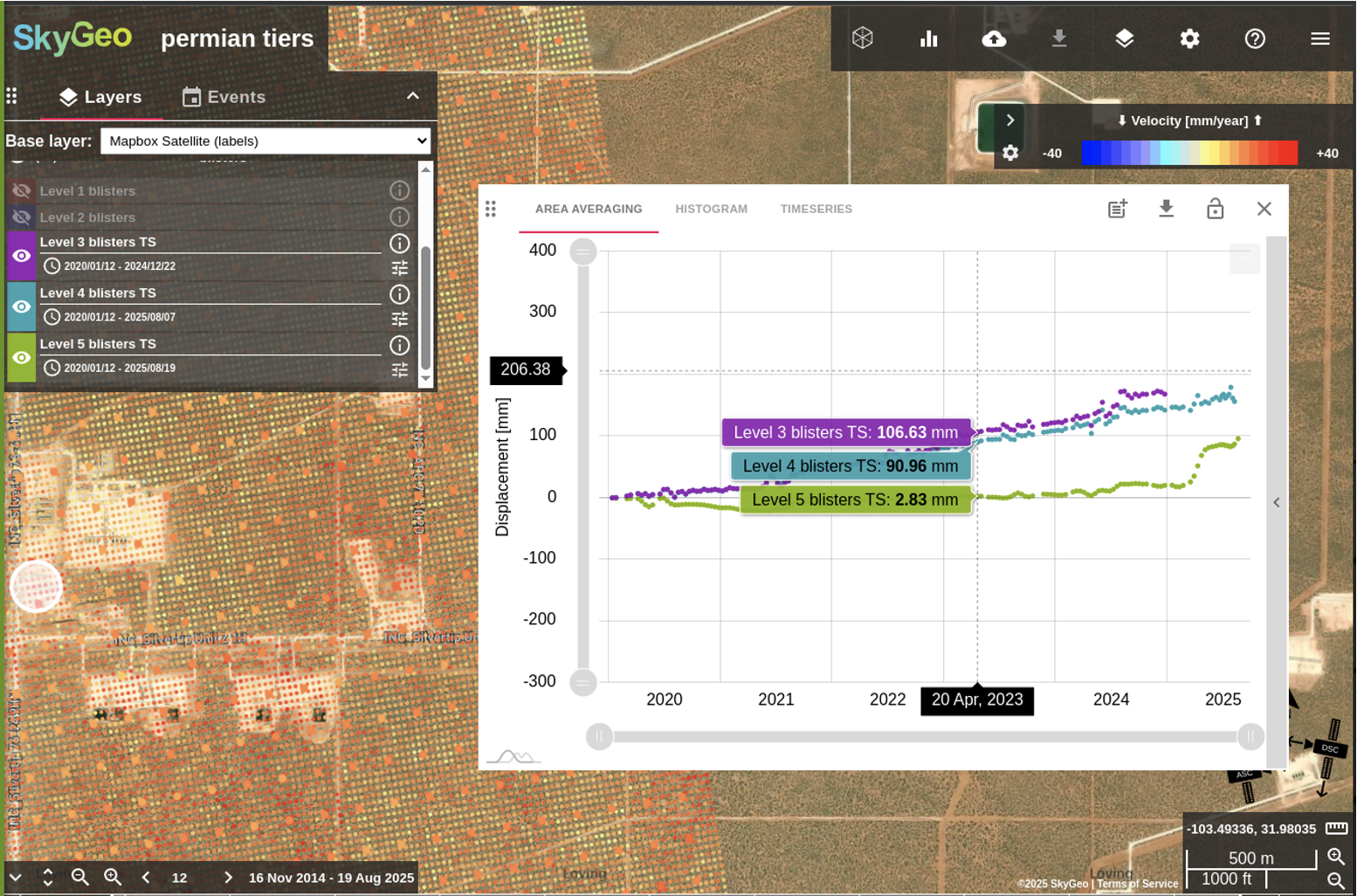
InsideInSAR is your starting point, not your final answer. When decisions affect safety, production or long-term asset value, SkyGeo’s low-risk, higher-level services provide the extra quality and interpretation you need.
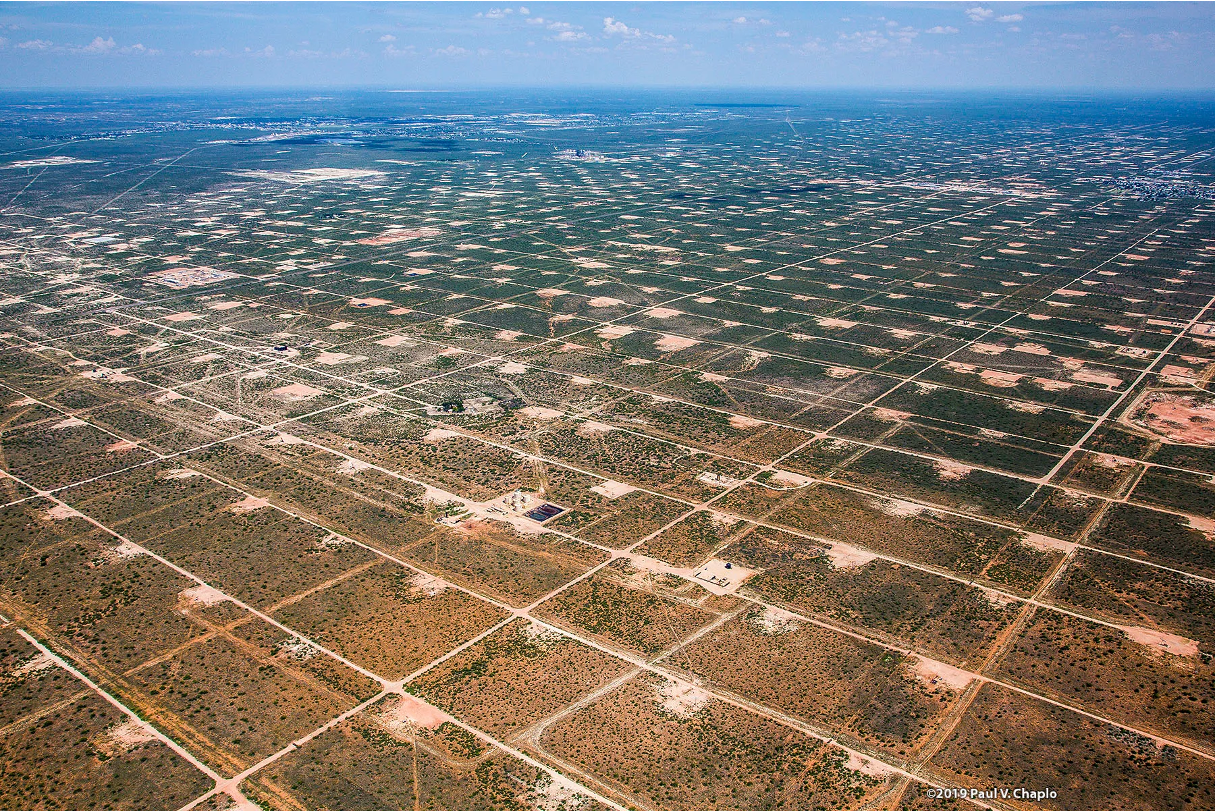
The Permian Basin is one of the most intensively developed hydrocarbon basins in the world. Injection, production, water handling and infrastructure build-out all change the stress in the subsurface – and the ground responds.
InsideInSAR makes that response visible.
Using satellite radar (InSAR), we provide a baseline, basin-wide view of slow ground motion across the Permian Basin. It’s free to use, so operators, midstream owners, regulators and researchers can all start from the same baseline picture.
The map is:
Wide-area and long-term – covering the Midland, Delaware and Central Basin Platform with several years of history.
Lowest-quality, hence high-risk for decision-making - if you’re after decisions, reach out to SkyGeo for higher-level products.
Built by SkyGeo for the Permian Basin Community
InsideInSAR is created and operated by SkyGeo, the company behind the longest-running InSAR monitoring in the Permian Basin and a global benchmark for turning satellite measurements into decision-grade ground-motion insight for energy, infrastructure and public agencies.
This public map is a deliberately entry-level view of what InSAR can reveal over the basin: a free way for the community to explore basin-scale uplift and subsidence and get familiar with the technology.
When your risk tolerance is low and decisions touch safety, integrity, regulation or major investment, relying on this map alone is a high-risk choice; SkyGeo’s premium services carry the same monitoring backbone much further, with higher-fidelity products, analytics and support designed to help you avoid unpleasant surprises.
Clarity Backed by Expertise
-
InsideInSAR is a free, basin-wide ground-motion resource for the Permian Basin, powered by SkyGeo. It uses satellite InSAR to make long-term patterns of uplift and subsidence visible across the Midland Basin, Delaware Basin and Central Basin Platform. It is designed as a shared screening baseline: a place to see where the ground is moving before deciding whether a location needs more detailed analysis.
-
Use the free map to explore basin-scale uplift and subsidence, compare locations and identify areas that may deserve a closer look. It is useful for early screening, building regional context and starting technical conversations across operators, midstream teams, regulators and researchers. If a decision affects safety, integrity, production or significant capital, move from the public view to a higher-fidelity monitoring and interpretation workflow.
-
Do not use the public map as a standalone basis for a high-consequence operational or engineering decision. Basin-wide screening cannot reliably isolate every local signal, attribute movement to a particular well or prove why the ground is moving. For asset-level decisions, the InSAR needs to be processed and interpreted in the local geological, operational and monitoring context.
-
The Permian Basin is an active subsurface system. Production, saltwater disposal, fluid migration, pressure changes, geology and natural ground behaviour can all contribute to surface movement. InSAR shows the surface response, but the cause has to be tested against operational and subsurface evidence rather than assumed from the map alone.
-
The map can help you see whether regional uplift or subsidence is present near an asset, but it is an entry-level basin view rather than a local integrity assessment. Local decisions need higher-resolution processing, quality control and interpretation against well locations, injection and production history, geology and other monitoring. That is the step that turns a visible pattern into useful operational evidence.
-
In some cases, a time series can reveal persistent or accelerating uplift or subsidence before a problem is obvious at the surface. That should be treated as early awareness, not a universal failure-prediction system. The Crane County work described on InsideInSAR shows why historical time series and expert interpretation matter, while the contrasting Toyah case shows that not every failure mechanism produces a detectable deformation precursor.
-
InsideInSAR is built for people who need a common view of Permian Basin ground behaviour: operators, reservoir and geomechanics teams, midstream and integrity teams, environmental specialists, regulators, landowners and researchers. The public map creates a shared starting point; the level of analysis should then increase with the consequence of the decision.
-
First, capture the location and review the pattern in its wider basin context. Then compare it with what your team knows about nearby wells, injection, production, geology, seismicity and asset condition. If the movement is persistent, accelerating or operationally important, request a local review rather than acting on the public map alone.
Contact Us
Have a question about what you’re seeing in the map or whether you need higher-grade monitoring? Share a few details about your assets and objectives and a SkyGeo specialist will get back to you with the best next step.